
Disney Research has shared a new video demonstrating “ReActor,” a research project focused on transferring human motion to robots with very different body shapes and movement capabilities.
Disney Research Solving for Shortcomings in Robotic Motion
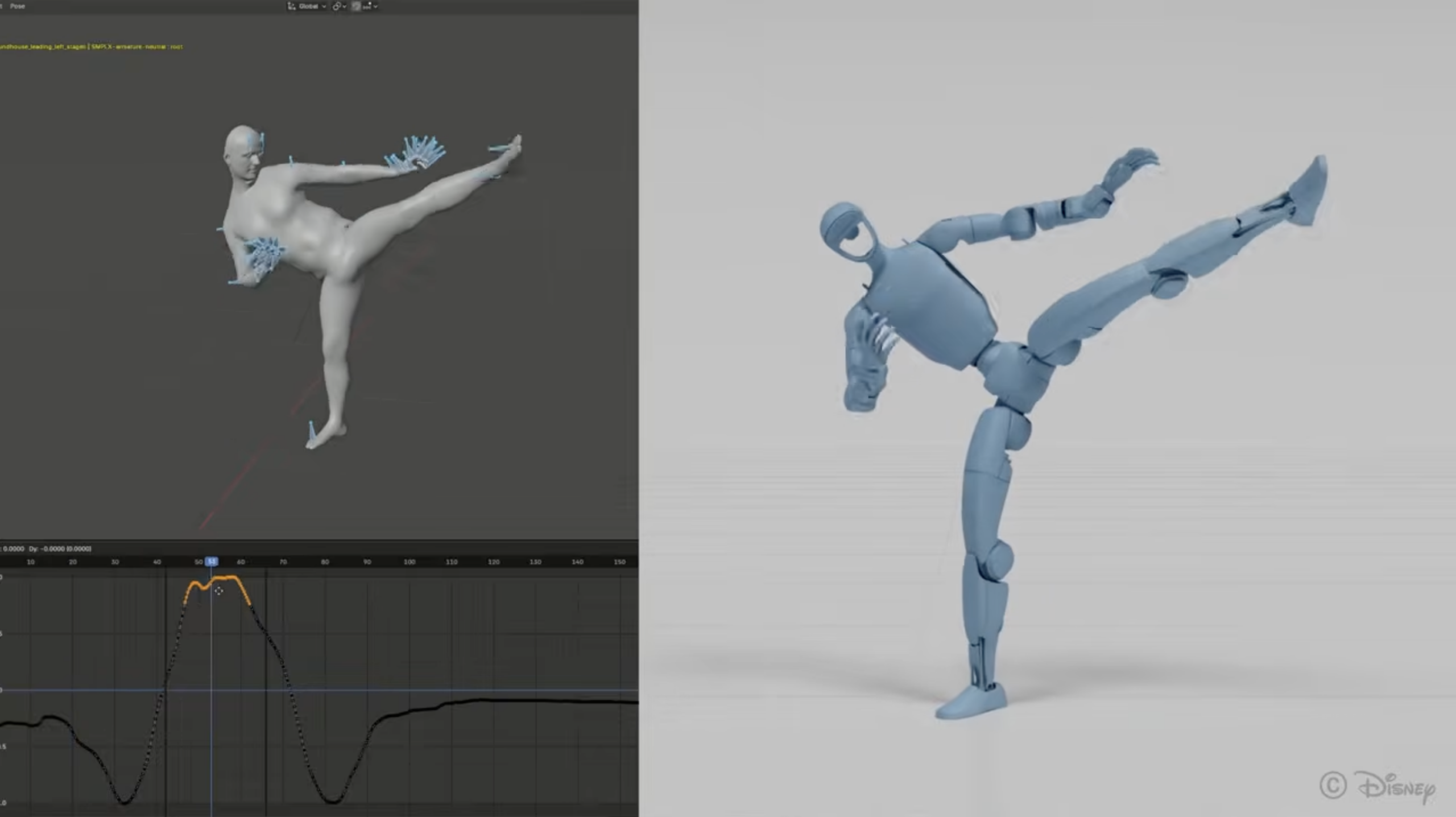
The motion-learning technology demonstrated in this project could mark a significant improvement for robotic movement across any application.
A portion of the abstract for the full research paper reads as follows:
Retargeting human kinematic reference motion onto a robot’s morphology remains a formidable challenge. Existing methods often produce physical inconsistencies, such as foot sliding, self-collisions, or dynamically infeasible motions, which hinder downstream imitation learning. We propose a bilevel optimization framework that jointly adapts reference motions to a robot’s morphology while training a tracking policy using reinforcement learning … We validate our method in simulation and on hardware, demonstrating challenging motions for morphologies that differ significantly from a human, including retargeting onto a quadruped.
In simpler terms: the existing methods used to teach robots humanlike movement tend to fall short when aiming for smooth, 1:1 human motion. A proposed system from Disney Research offers a new layered learning method, where the program takes the original source motion and analyzes how to best match the movement if the source body more closely matched the target robot’s design.
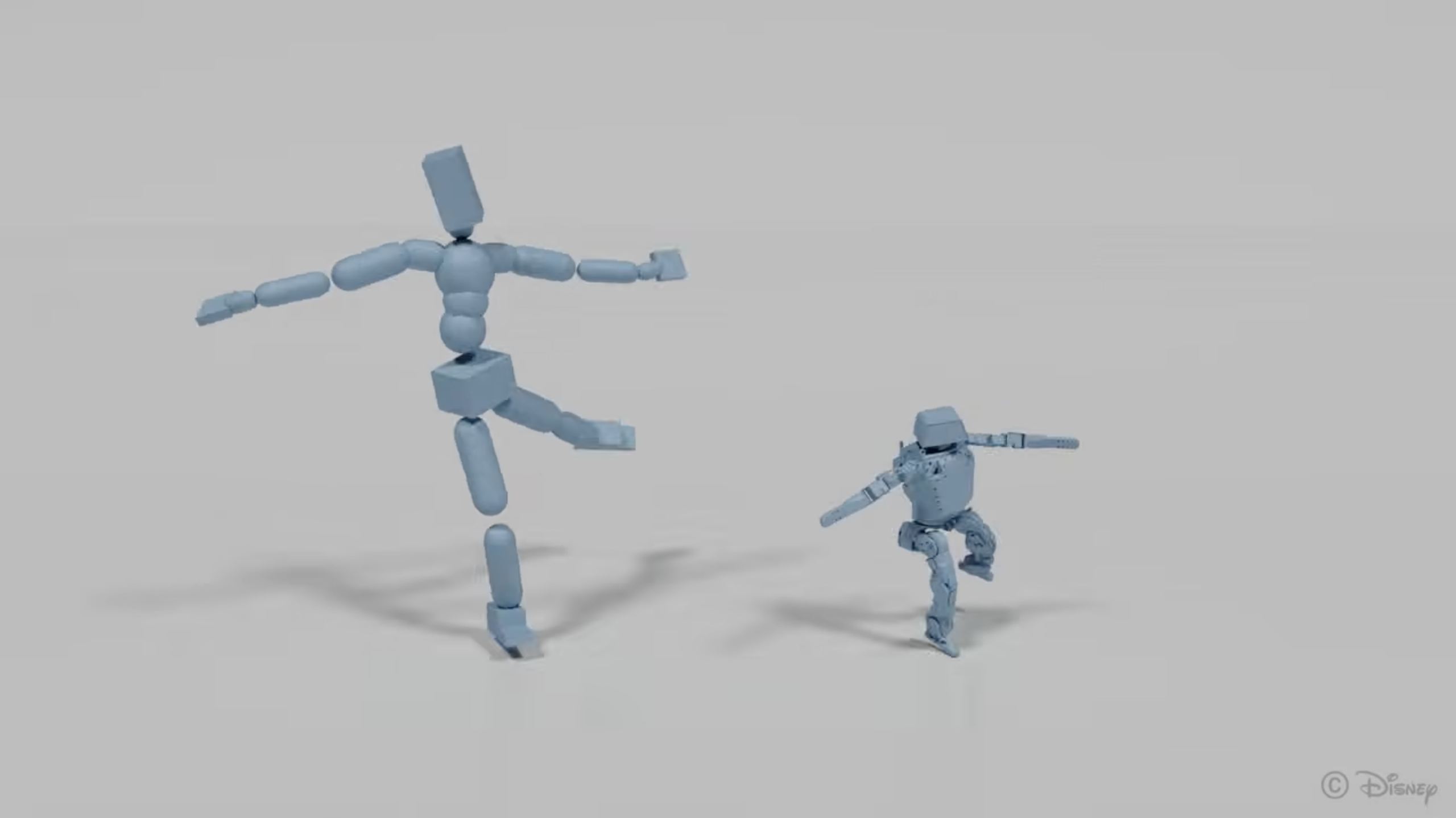
The project, formally titled “ReActor: Reinforcement Learning for Physics-Aware Motion Retargeting,” was developed by researchers David Müller, Agon Serifi, Sammy Christen, Ruben Grandia, Espen Knoop, and Moritz Bächer, a team from Disney Research in Switzerland.
The video from the team offers a visual demo of human motion being adapted to multiple robotic forms, including two humanoid robots and a quadruped robot, using multiple targeting methods compared against Disney’s ReActor method.
The overall goal is to preserve the nuanced qualities of a human performance while making the resulting motion physically plausible for machines with different sizes, proportions, degrees of freedom, and joint limitations.
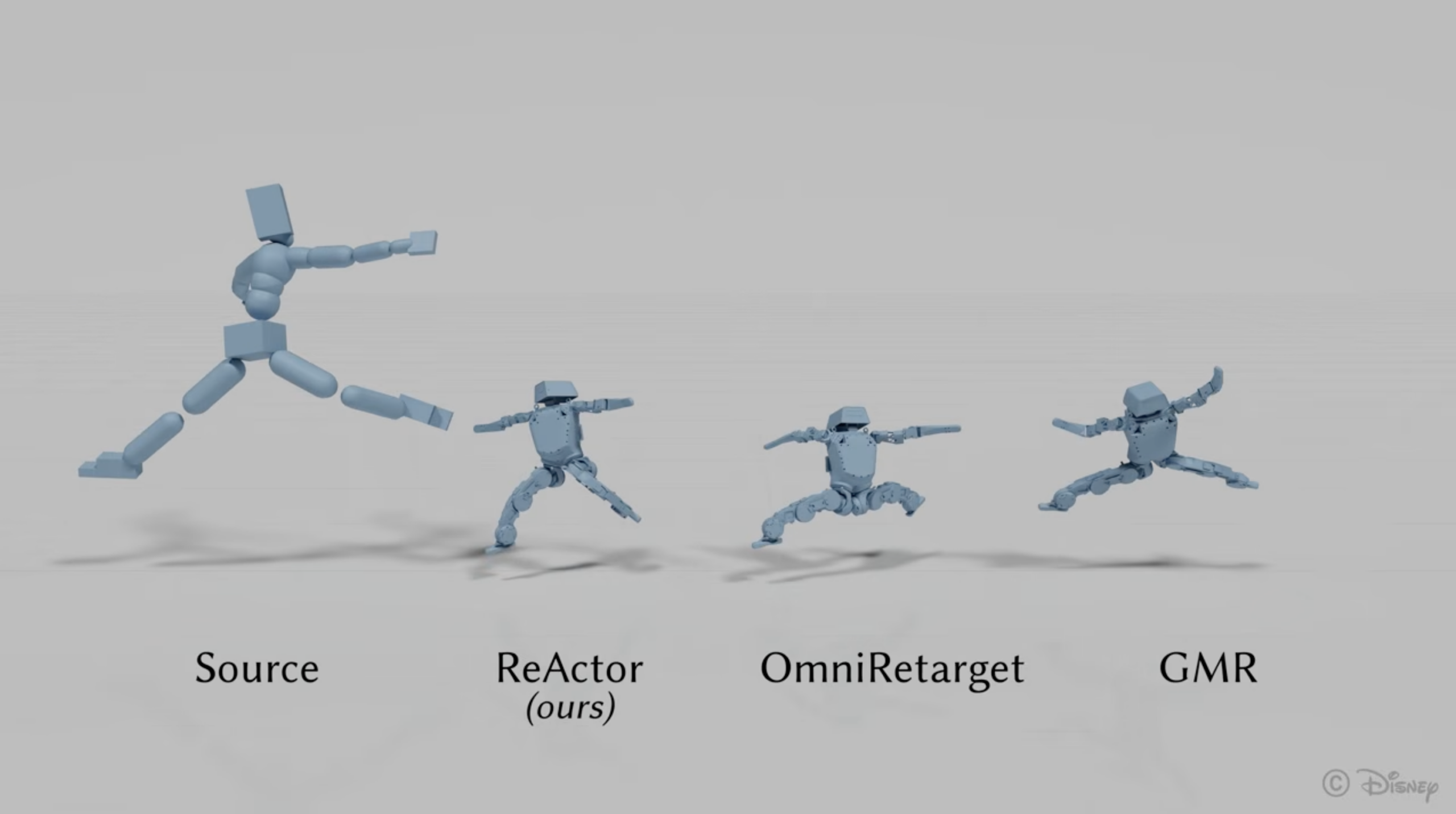
Existing methods that work toward this goal have historically encountered issues overcoming technical errors in translating motion from human sources to robots or simulated models. These can include foot sliding, self-collisions, ground penetration, floating feet, or movements that are not physically achievable for the target robot.
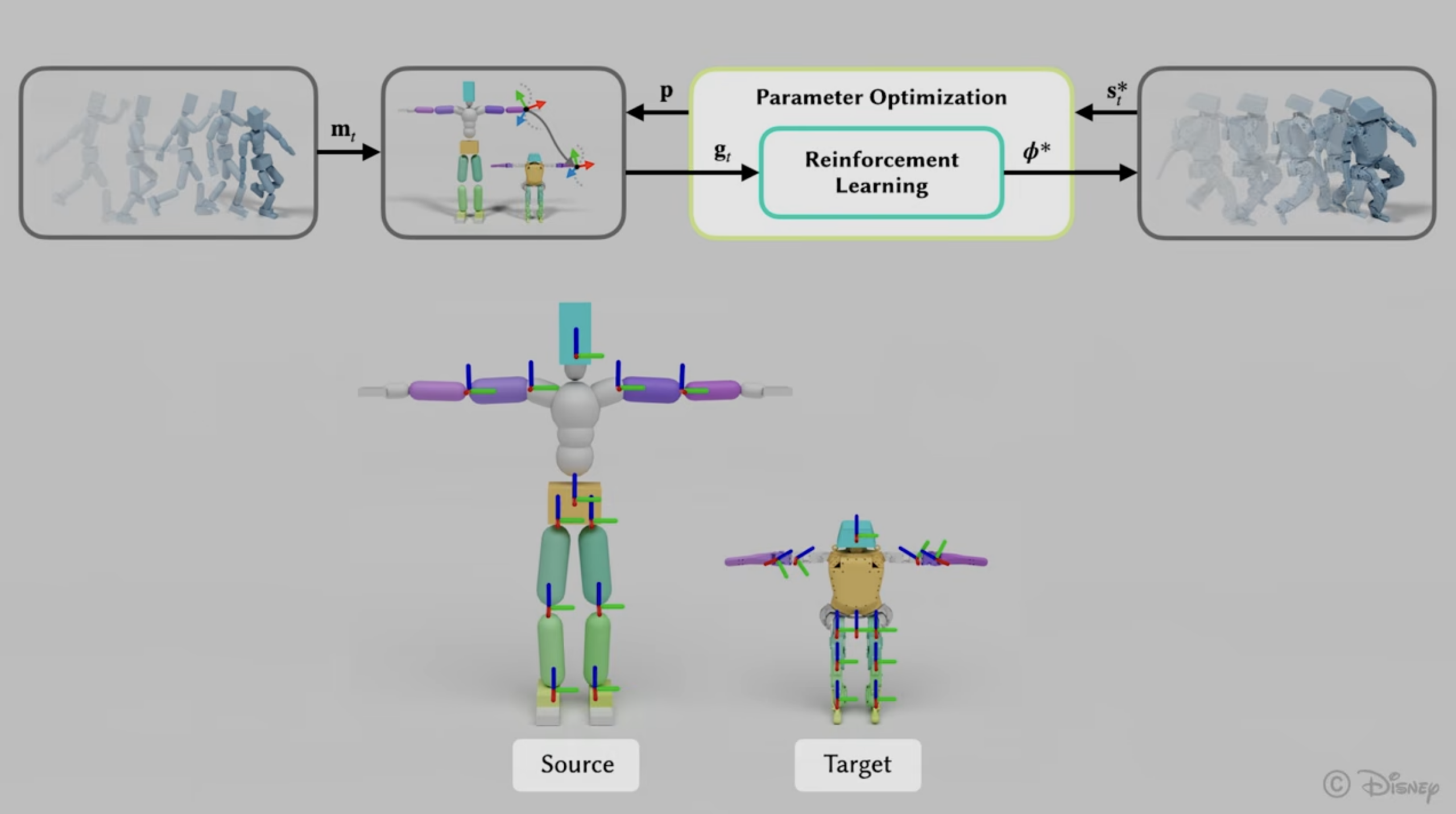
Disney’s ReActor addresses those issues by combining reinforcement learning with physics simulation, allowing the system to adapt the motion while also training a control policy to track it.
The system uses what the researchers describe as a “bilevel optimization” framework. The method adjusts the reference motion at one level while simultaneously training the robot to follow that motion at another level.
Rather than requiring extensive manual tuning, the system requires fewer body-part links between the source and target, such as matching relevant human body segments to comparable parts of the robot.
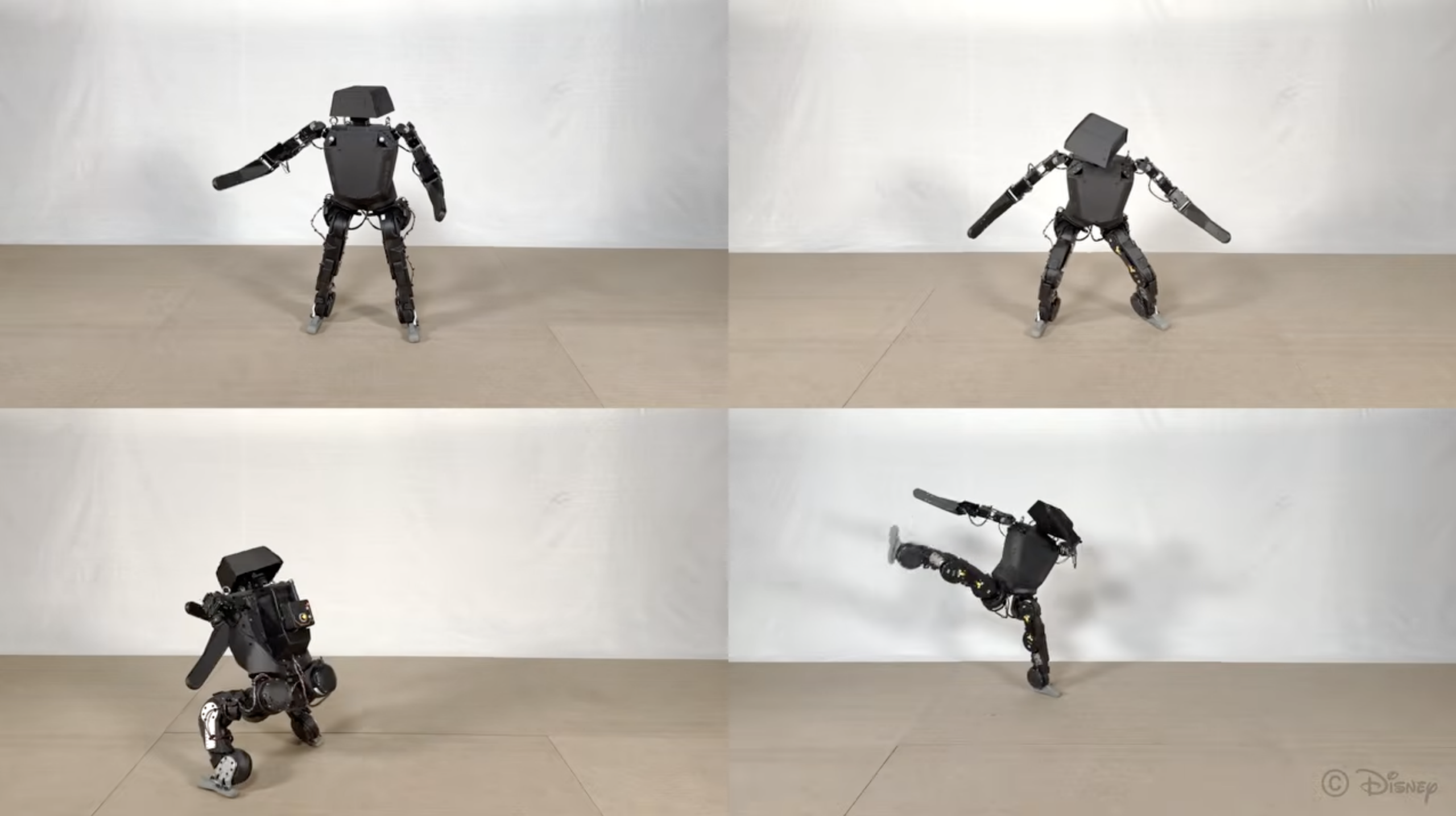
As demonstrated in the video and according to the full paper, the method performed better than baseline approaches in several areas, including its success in avoiding all of the technical errors described earlier.
The researchers also note that the system was validated both in simulation and on physical hardware, as shown with the live robot demo toward the end of the video.
Check out the full demonstration from Disney Research on YouTube:
While the project itself is dense and highly technical, the broader implications are easy to understand for Disney fans: the work could eventually support more lifelike robotic characters, interactive entertainment figures, or performance-driven animatronics, which have traditionally required more arduous fine-tuning for believable humanlike movement.
The work on ReActor is still brand new, so there are no official comments from the company regarding its potential use in the future. Regardless, the project continues the company’s long-running interest in robotics, animation, and character performance technology.
You can check out the full paper from Disney Research posted on arxiv.org.
Do you have any experience in the fields of robotics or animation? What are your thoughts on this work coming out of Disney Research? Join the discussion with us on social media.
For the latest Disney Parks news and info, follow WDW News Today on Twitter, Facebook, and Instagram.