
The bells of Notre Dame are ringing for a major milestone, as 2026 marks the 30th anniversary of Disney’s The Hunchback of Notre Dame.
Disney’s The Hunchback of Notre Dame Turns 30
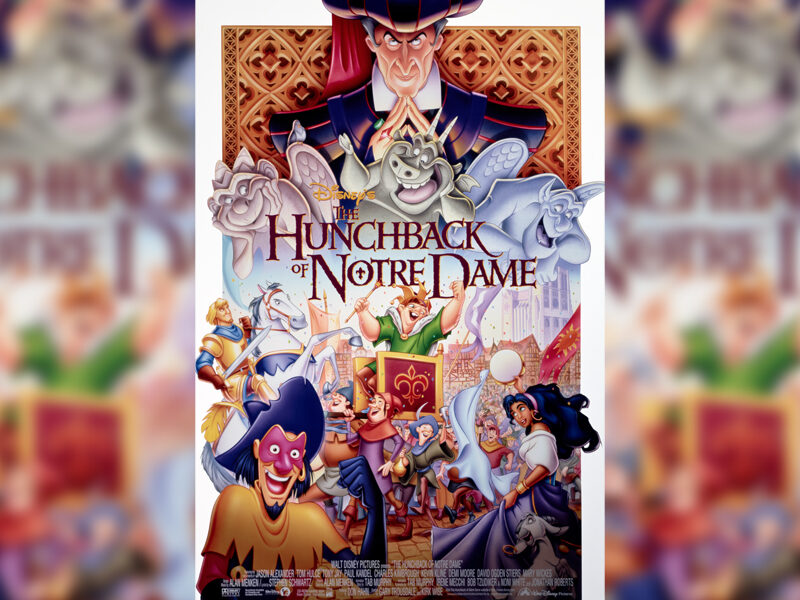
D23 and Walt Disney Archives shared a new Archives Spotlight feature in honor of the The Hunchback of Notre Dame’s 30th anniversary. The film was released on June 21, 1996, bringing Disney’s animated take on Victor Hugo’s 1831 novel to theaters during the Disney Renaissance era.
As described in the spotlight, Disney’s film followed several earlier screen adaptations of Hugo’s story, including the 1923 silent film starring Lon Chaney and the 1939 film featuring Charles Laughton as Quasimodo. Disney’s version reimagined the tragic literary material as a sweeping animated musical centered on Quasimodo, Esmeralda, Judge Claude Frollo, Captain Phoebus, and the cathedral of Notre Dame itself.
According to the Walt Disney Archives, development on the film began in early 1993 after the project was suggested by David Stainton, then serving as vice president of Creative Affairs for Walt Disney Feature Animation. Members of the production team traveled to Paris for research, studying Notre-Dame de Paris up close, including its towers, hidden spaces, and architectural details.
The film marked an important first for Disney animation overseas: The Hunchback of Notre Dame was the first production from Disney’s Paris animation studio, with artists in both the United States and France contributing to the project. The Paris team was led by brothers Paul and Gaëtan Brizzi.
A Darker, More Dramatic Look for Disney Animation
One of the central focuses of D23’s retrospective is the film’s distinctive visual style. Rather than giving medieval Paris a romanticized fairy-tale sheen, the filmmakers pushed for something more atmospheric, weighty, and dramatic.
In an interview with The Disney Channel Magazine, co-director Kirk Wise detailed their considerations for the film’s visual tone:
“…early on, we talked with art director David Goetz about how we were going to make this vision of medieval Paris stand apart from Beauty and the Beast … we thought it needed a gritter feel. Dave took a lot of his cues from Hugo’s description of life in the streets, how there was heaven above and pretty much hell below in the streets of Paris.”
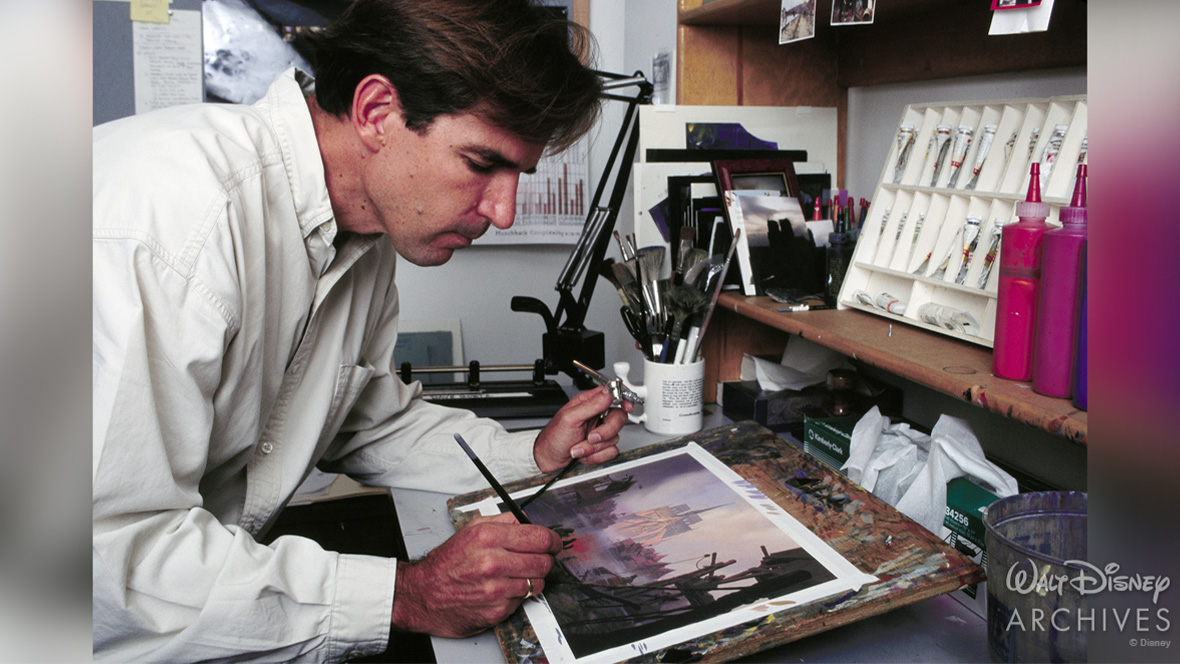
D23 shared an archival photo of Goetz at his desk, working with paint and airbrush tools on a detailed production image. His workspace is filled with brushes, paint tubes, and reference material, offering a behind-the-scenes glimpse at the hand-crafted artistry behind the film.
Goetz and the team looked to artists such as N.C. Wyeth and Edward Hopper for visual inspiration. They also drew from Victor Hugo’s own artwork, which helped shape the film’s shadowy and expressive design language.
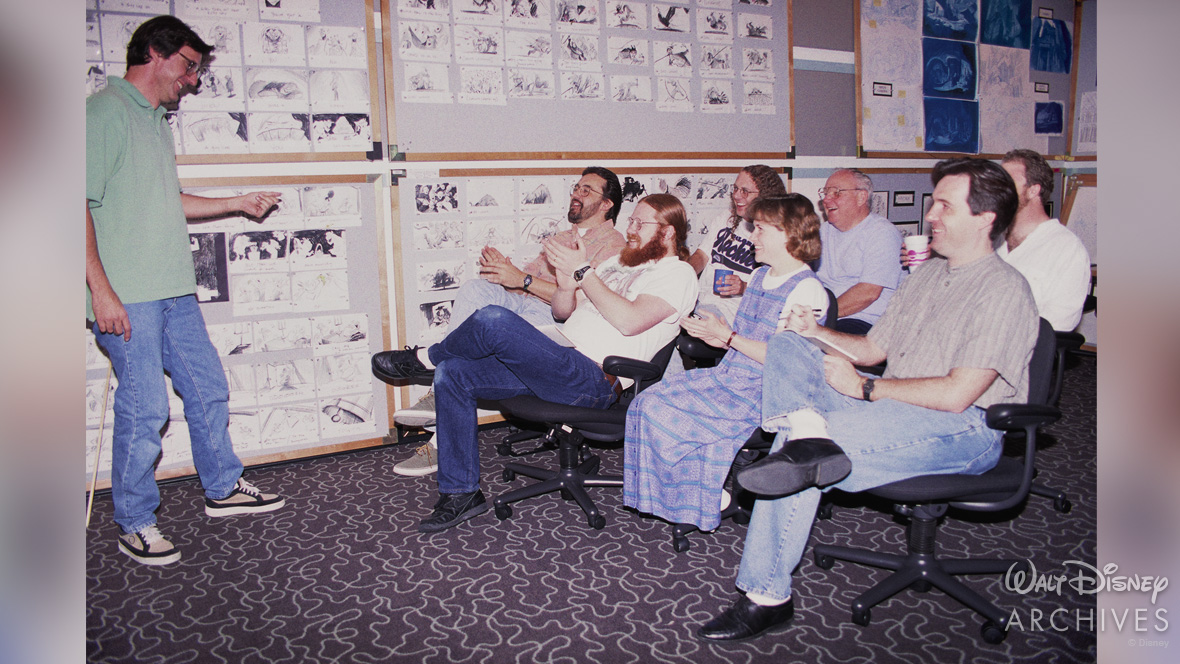
D23 included a photo from a story meeting for the film, showing several members of the production team reviewing storyboard panels pinned across the wall. Among those pictured are producer Don Hahn, directors Gary Trousdale and Kirk Wise, Kevin Harkey, Jeff Snow, and Disney Legend Burny Mattinson.
Hugo’s sprawling novel contains multiple points of view and features a much darker subject matter than most Disney animated films up to that point, requiring the filmmakers to carefully shape the material for a new audience while preserving its emotional, dramatic core.
The team ultimately made Quasimodo the heart of the film. In Disney’s take, the story becomes a deeply empathetic portrait of an isolated outsider who longs to experience the world beyond the cathedral walls.
Designing Quasimodo
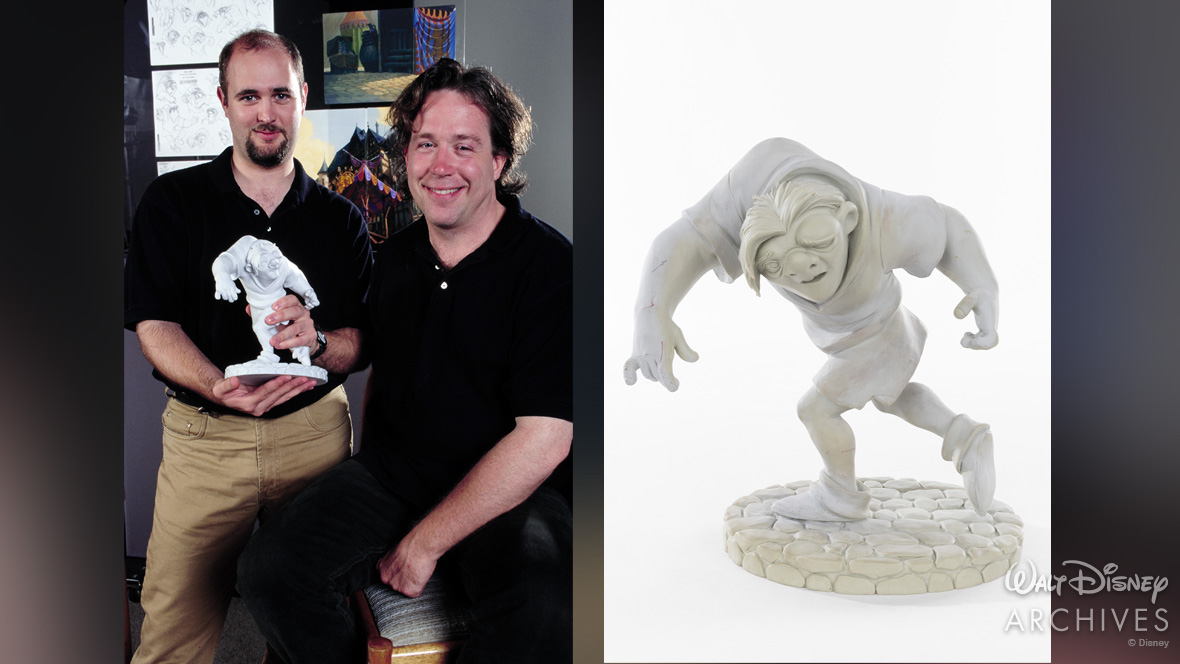
D23 also shared a production photo of supervising animator James Baxter with Tom Hulce, the voice of Quasimodo. The two are pictured with a sculpted animator’s model of the character, while the same archival image includes a close-up look at the Quasimodo maquette.
Quasimodo’s character design was carefully constructed to express both his physical condition and his emotional state. Baxter emphasized more rounded, horizontal shapes for Quasimodo, contrasting him against the vertical severity of Notre Dame’s towers and the intimidating presence of Frollo.
Baxter noted the subtle symbolic importance of Quasimodo’s disfigured form:
“(Quasimodo’s) being bent over was a metaphor for his wanting to hide. We wanted him wrapped in on himself, able to bend over and cower in his most oppressed moments.”
The design, on a technical level, had to support the character’s agility. Though Quasimodo is hunched and physically closed off from the world, he also moves through the cathedral with speed and confidence, climbing across bells, ledges, and stonework with ease, in flowing movements that emphasize his curved physique.
Designing Esmeralda
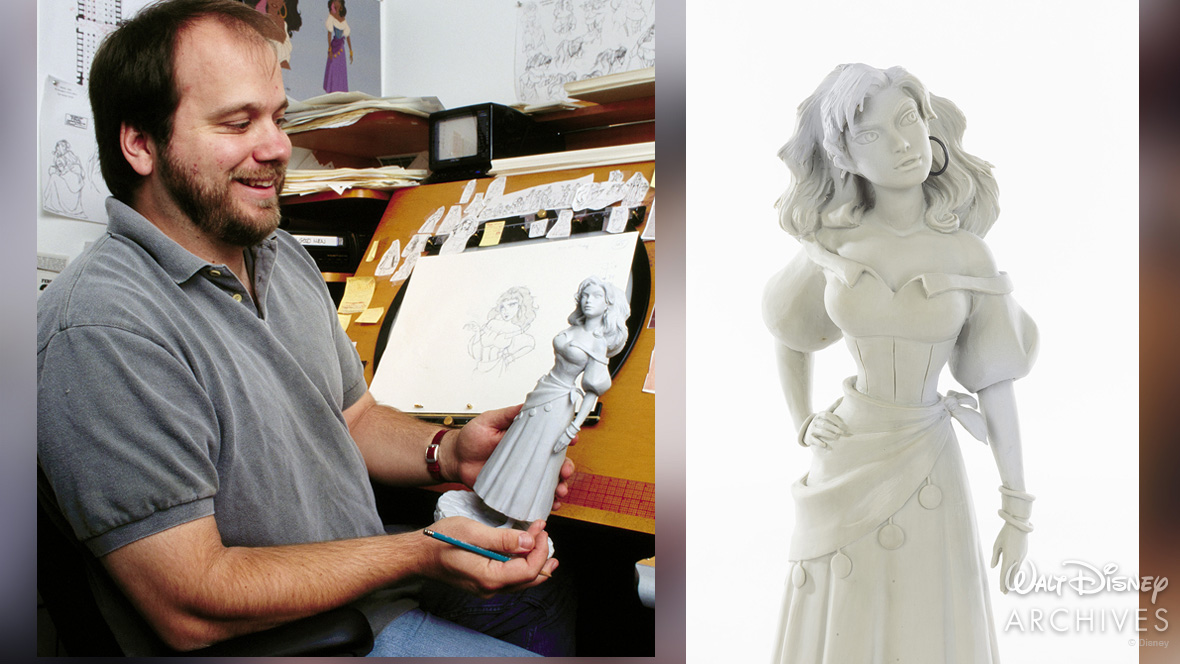
Another archival image features Tony Fucile, supervising animator for Esmeralda, holding an animator’s model of the character at his desk. A second image provides a close-up of the Esmeralda maquette.
D23’s article describes Esmeralda as a key emotional connection for Quasimodo. Like him, she is an outsider in the world of the film, but she meets him with compassion rather than fear. Her friendship helps Quasimodo begin to see himself as more than what Frollo has taught him to believe.
Esmerelda presents Quasimodo with an inspiring conviction, embodying the belief that all people deserve compassion and respect, and the oppressive evils of the world should be met with resistance and defiance. As Trousdale noted:
“…she’s dealt with persecution her entire life and it’s toughened her. But beneath that tough exterior, there’s tenderness and compassion. What she wishes for more than anything else is the world is that all prejudice could be stripped away and people could look at each other as they really are.”
The character’s design reflects that balance. Fucile and the animation team shaped Esmeralda to feel warm, spirited, and strong, with a visual presence that communicates both tenderness and resilience.
A Disney Film With a Lasting Legacy
Nearly three decades after its original release, The Hunchback of Notre Dame remains one of Disney’s boldest animated features. Its Gothic imagery, mature themes, and powerful Alan Menken and Stephen Schwartz score set it apart from many other films of the Disney Renaissance.
Disney Parks fans can commemorate the anniversary with a new collectible doll available at Walt Disney World. You can also find a brand new Hunchback Spirit Jersey on Disney Store, which was just released.
Earlier this year, guests attending Disneyland After Dark: 70 Years of Favorites got to meet Esmerelda, who doesn’t often appear in the parks.
The D23 retrospective closes by encouraging fans to revisit Quasimodo’s story on Disney+, where The Hunchback of Notre Dame is currently streaming.
What are your memories of seeing The Hunchback of Notre Dame for the first time? Let us know on social media.
For the latest Disney Parks news and info, follow WDW News Today on Twitter, Facebook, and Instagram.