

Joe Rohde, Disney Legend and former Walt Disney Imagineering executive designer and vice president, has responded to the viral Wall Street Journal report about the recent tumultuous years at Walt Disney Imagineering.
Joe Rohde Responds to Wall Street Journal

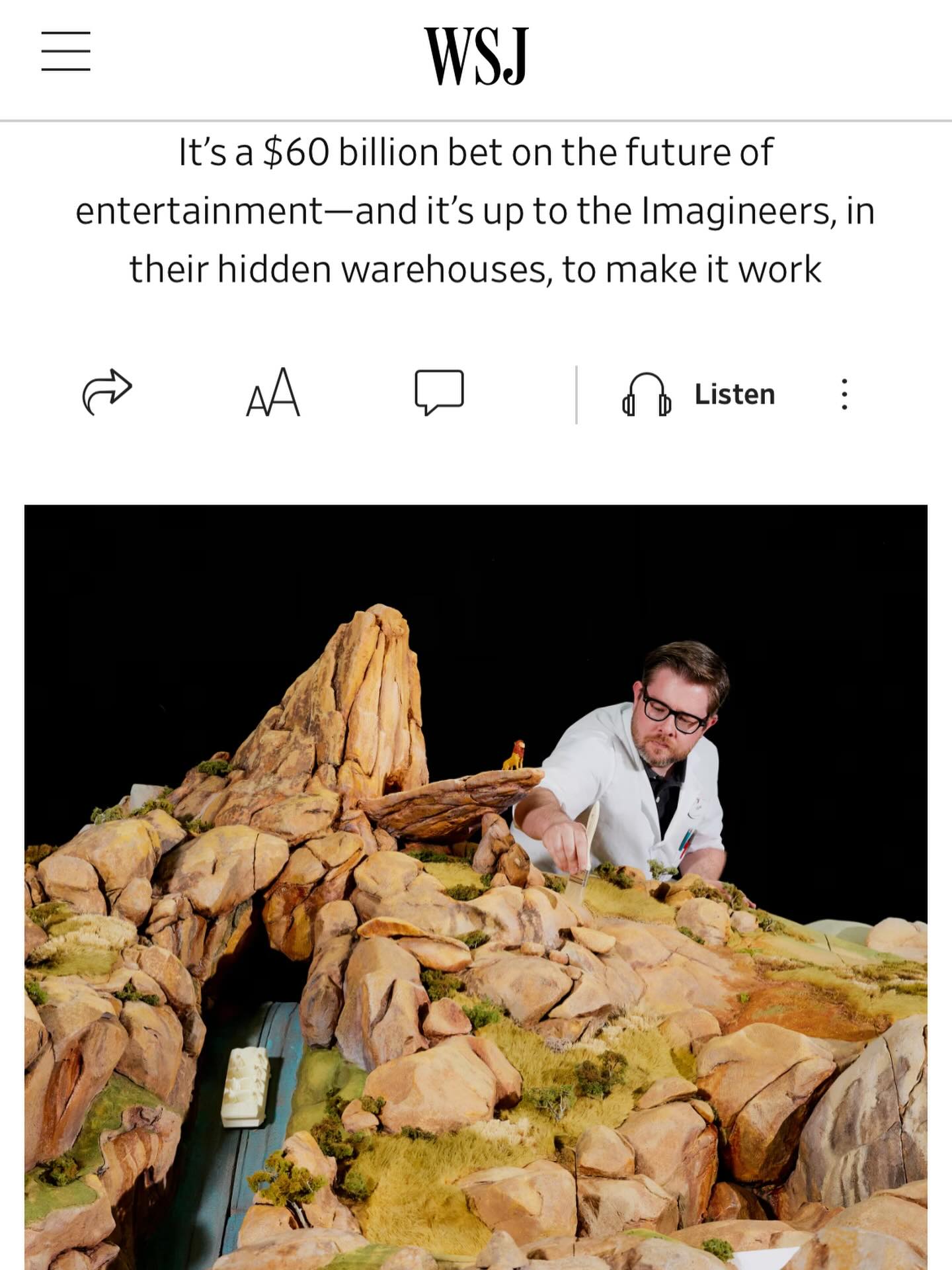
The following paragraph is in the recent Wall Street Journal feature on Walt Disney Imagineering and its recent creative struggles with executives:
Some Imagineers saw executives as an obstacle that needed to be overcome. They sometimes used a process known internally as “progressive seduction” to get approval for projects at a smaller scale and then suggest one seemingly small improvement at a time until it was as big as they actually wanted it to be, a person with knowledge of the matter said.
This “progressive seduction” led to executives losing trust in Walt Disney Imagineering to stick to plans’ scope and scale, which resulted in layoffs, budget restrictions, and scrapped projects, including additional missions for Millennium Falcon: Smugglers Run, a reimagined Tomorrowland at Disneyland, and a Mega Marvel E-ticket ride.

Disney Legend Joe Rohde posted the following statement on his Instagram account to counter the statement about “progressive seduction”:
His comment reads:
There is a paragraph in the Wall Street Journal article about Imagineering that is pretty much a fantasy. It mentions the concept of progressive seduction. This refers to the notion that a team presents a project with a reasonable budget but fully intends to escalate this budget by adding scope and by misrepresenting the true cost of original scope.
I saw this happen once in 40 years. Once. Decades ago. I was a very junior member of a team and the producer attempted to grow the scope and budget by about 30%. I was standing there in the meeting by the project model when we were told to cut the entire third of the project model off, chuck it and everything it represented, and build what was left. I will not say whether that project went on to completion… but I will say that it is psychotic to believe that a person would keep their job after deliberately deceiving the key executives of a major company to the tune of 100s of million dollars, and strangely naïve for a business journal to report it as if it could be true.
I have been in charge of projects that have gone over budget, been on budget, and come in below budget. In all cases, the general progression is a reduction in scope from the initial concept. Projects run over budget because of a combination of market forces, required changes in program after capitalization, and the unpredictability of technical innovation. Because there is already a cultural predisposition to imagine artists as irresponsible, it is exceedingly unproductive for designers to behave as such, and the result is not some tricky triumph, but the complete loss of authority over the project.
I would not want any young designer to think that progressive seduction was a legitimate form of design behavior recognized by anyone. Nor would I want a young business manager to suspect that this was the case, because it would lead to unproductive relationships within a team structure. I have no idea who the interview source was for this information, but it is described in a rather journalistically evasive way as “a person with knowledge of this matter.” I would contend that this is unlikely.
For the latest Disney Parks news and info, follow WDW News Today on Twitter, Facebook, and Instagram.